
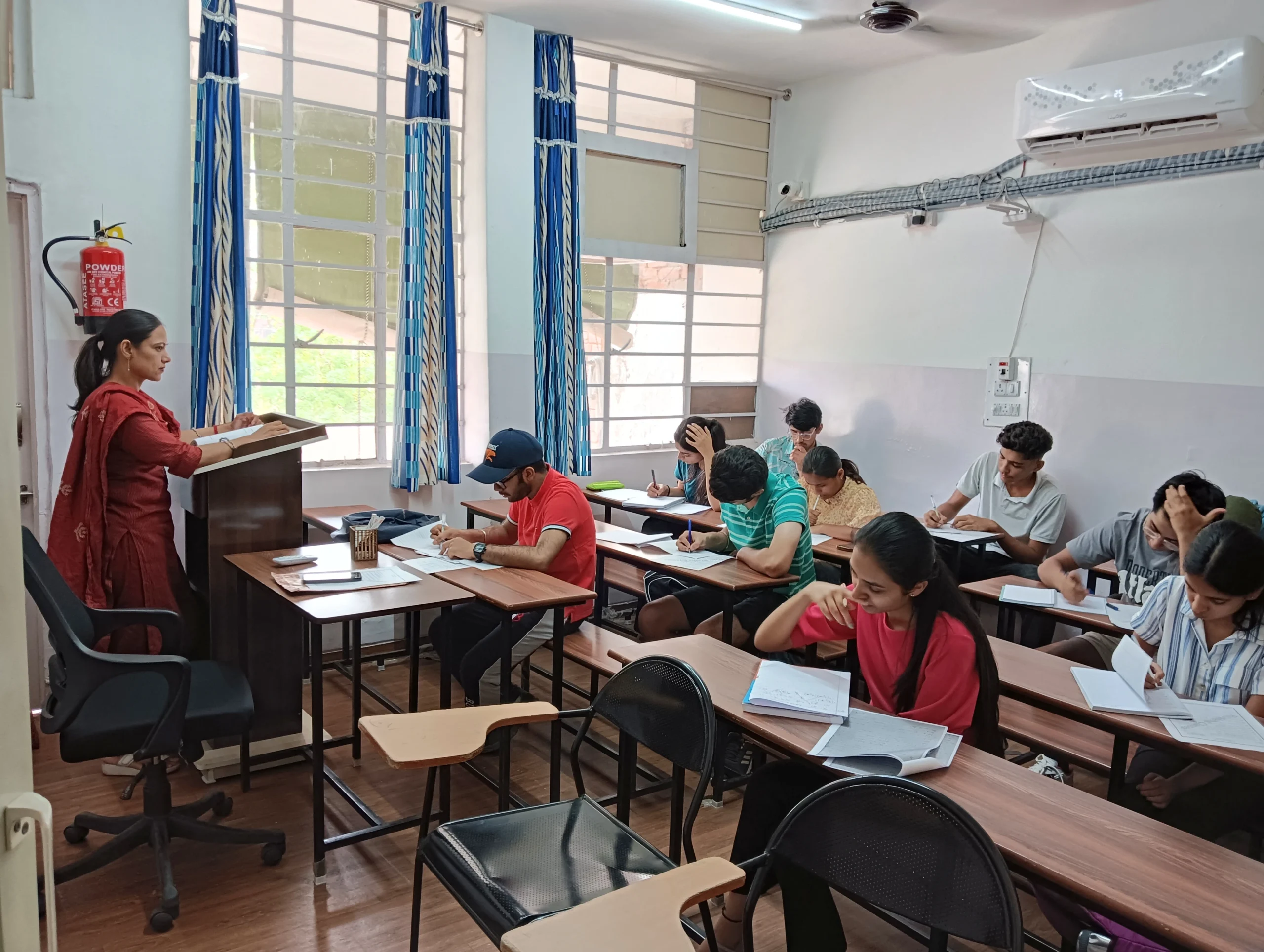
Here is a question I get asked all the time: “Ma’am, which chapter should I start with?”
And honestly, this is the smartest question a student can ask. Because where you start matters.
Think about it — if you begin with Integration (which is long and exhausting), and you get stuck on the third problem, what happens? You lose confidence. You start thinking, “Maths is too hard for me.” And then you avoid studying altogether.
But what if you started with a chapter that you could finish in 3-4 days? A chapter where questions follow a fixed pattern and you can actually see yourself solving problems correctly?
That changes everything.
In this guide, I am going to tell you exactly which chapters are easy to score in Class 12 Maths, how much time each one takes, and the smartest order to study them. This is the same strategy I have been teaching my students for over 10 years — and it works.
The truth about “easy” and “difficult” in Class 12 Maths
Let me be honest with you first.
No chapter is truly “easy” if you do not practice. And no chapter is impossible if you give it enough time. But some chapters are definitely more straightforward than others — they have fewer concepts, more predictable questions, and can be mastered faster.
Here is the complete picture:
| Chapter | Marks | Difficulty | Time to master | My verdict |
|---|---|---|---|---|
| Linear Programming | 5 | Easy | 3–4 days | Start here! |
| Probability | 8 | Easy–Moderate | 5–7 days | Very scoring |
| Vectors | 6 | Easy–Moderate | 5–7 days | Formula-based |
| 3D Geometry | 8 | Moderate | 7–10 days | Builds on Vectors |
| Matrices & Determinants | 10 | Moderate | 10–12 days | Practice-heavy |
| Differential Equations | 6–8 | Moderate | 10–12 days | Pattern-based |
| Relations & Functions | 8 | Moderate-Hard | 7–10 days | Conceptual |
| Continuity & Differentiability | 9–11 | Moderate-Hard | 10–14 days | Needs Class 11 base |
| Integration | 9–11 | Hard (but scoring) | 15–20 days | Most practice needed |
| Application of Derivatives | 6–8 | Hard | 10–12 days | Word problems |
| Application of Integrals | 4–5 | Moderate | 5–7 days | Area problems |
Now look at this table carefully. The first three chapters — Linear Programming, Probability, and Vectors — together give you 19 marks. And you can master all three in about 2-3 weeks.
Add 3D Geometry (which builds directly on Vectors), and you have 27 marks secured from relatively easier topics.
When you finish these four chapters first, something happens in your brain. You stop fearing Maths. You start believing you can do this.
And that confidence makes a huge difference when you finally sit down to study Calculus.
The easy chapters — let me explain each one
1. Linear Programming (5 marks) — The easiest 5 marks in your paper
I always tell my students to start here. Always.
Why is Linear Programming so easy?
- Only graphical method questions come in board exams — no complicated theory
- The steps are exactly the same for every problem: write constraints, draw graph, find corner points, calculate maximum or minimum
- If you can draw straight lines and shade regions, you can do this chapter
- Questions are predictable — diet problems, manufacturing problems, transportation problems
What to focus on:
- Converting word problems into mathematical inequalities
- Drawing accurate graphs (use graph paper while practicing)
- Finding corner points correctly
- Understanding bounded vs unbounded regions
NCERT exercises to complete: Exercise 12.1 and 12.2 — do every single problem. There are not many, and they cover all question types.
Time needed: 3-4 days of focused practice. That is it. After that, you own these 5 marks.
2. Probability (8 marks) — Pattern-based and very scoring
Probability can feel confusing at first. Students often mix up formulas and get lost in conditional probability questions.
But here is the secret — once you understand the basic concepts, the questions become very predictable. CBSE asks similar types of problems every year.
Topics you must master:
Conditional Probability — P(A|B) type questions. Know the formula: P(A|B) = P(A∩B) / P(B). Practice identifying when to use it.
Bayes’ Theorem — This comes almost every year. It looks complicated but follows a fixed pattern. The trick is to identify the “causes” and the “effect” in the problem.
Probability Distribution — Finding mean (expected value) of a random variable. Usually straightforward calculation once you set up the table correctly.
My pro tip for Bayes’ Theorem:
Always draw a tree diagram. I know it takes an extra minute, but it makes the solution visual and you are far less likely to make mistakes. When my students started drawing tree diagrams, their accuracy in Probability went up significantly.
Time needed: About 5-7 days to get comfortable with all types of problems.
3. Vectors (6 marks) — Visual and formula-based
If you can visualize things in 3D space, Vectors will feel intuitive. If you cannot visualize easily, do not worry — the formulas still work the same way.
Why students find Vectors manageable:
- Most questions are direct formula application
- No long derivations or complicated theory
- Once you memorize the formulas, solving becomes mechanical
Key formulas you must know:
- Dot product (scalar product) — and its use in finding angles between vectors
- Cross product (vector product) — and its use in finding area of parallelogram/triangle
- Scalar triple product — for finding volume of parallelepiped
- Projection of one vector on another
- Direction cosines and direction ratios
Important: Master Vectors before moving to 3D Geometry. The concepts are directly connected, and 3D Geometry becomes much easier if your Vector basics are strong.
Time needed: 5-7 days for Vectors alone.
4. Three-Dimensional Geometry (8 marks) — Extension of Vectors
Once you have done Vectors, 3D Geometry is like the next level of the same game. You are using the same vector operations, just applying them to lines and planes in 3D space.
Topics to focus on:
- Equation of a line in 3D (vector form and Cartesian form)
- Equation of a plane (different forms)
- Angle between two lines, two planes, or a line and a plane
- Shortest distance between two skew lines
- Distance of a point from a plane
The questions are formula-heavy but not conceptually difficult. If you know which formula to apply, you can solve most problems correctly.
Time needed: 7-10 days after completing Vectors.
- Linear Programming: 3–4 days → 5 marks secured
- Probability: 5–7 days → 8 marks secured
- Vectors: 5–7 days → 6 marks secured
- 3D Geometry: 7–10 days → 8 marks secured
Total: About 3–4 weeks → 27 marks out of 80
That is more than one-third of your paper done in the first month, and these are among the easier chapters!
Bonus: Matrices and Determinants (10 marks) — easier than it looks
I want to add one more chapter to your “easier” list — Matrices and Determinants.
Now, I know what you are thinking. “Ma’am, Matrices has so many operations to remember!” Yes, it does. But here is the thing — once you practice those operations a few times, they become automatic. There is no deep conceptual thinking required. It is mostly mechanical.
What makes Matrices scoring:
- Operations follow fixed rules — addition, multiplication, transpose
- Determinant calculation is purely mechanical (just follow the expansion method)
- Finding inverse of a matrix — same steps every time
- Solving system of equations using matrices — very predictable
The only challenge is accuracy. One small calculation mistake and your whole answer goes wrong. So practice carefully, double-check your arithmetic, and you can score full marks here.
With Matrices added, you now have 37 marks from relatively straightforward chapters. That is nearly half the paper.
Now let us talk about Calculus (the part everyone worries about)
Calculus carries 35 marks — the biggest chunk of your paper. You cannot skip it. But you can approach it smartly.
Here is how those 35 marks are actually divided:
| Calculus topic | Marks | Difficulty level |
|---|---|---|
| Continuity and Differentiability | 9–11 marks | Moderate-Hard |
| Application of Derivatives | 6–8 marks | Hard (word problems) |
| Integration (including definite integrals) | 9–11 marks | Needs most practice |
| Application of Integrals | 4–5 marks | Moderate |
| Differential Equations | 6–8 marks | Pattern-based |
Why does Calculus feel hard?
- It builds on Class 11 concepts. If your basics are weak, Class 12 Calculus will feel overwhelming.
- Integration has many methods (substitution, partial fractions, by parts) and you need to recognize which one to use.
- Application of Derivatives involves word problems, which require reading comprehension along with maths skills.
- The problems are longer, so you need stamina and focus.
But here is the good news:
Calculus is hard at the beginning. Once you practice enough problems (I am talking 100+ integration problems), patterns start to emerge. You start recognizing question types. And then it becomes manageable — not easy, but manageable.
The key is to not start with Calculus. Build your confidence with easier chapters first. When you sit down to study Integration after scoring well in Vectors and Probability practice tests, your mindset is completely different.
The smart order to study Class 12 Maths chapters
Based on everything I have explained, here is the order I recommend:
| Order | Chapter | Time | Why this order |
|---|---|---|---|
| 1 | Linear Programming | 3–4 days | Quick win, builds confidence |
| 2 | Probability | 5–7 days | Pattern-based, scoring |
| 3 | Vectors | 5–7 days | Foundation for 3D Geometry |
| 4 | 3D Geometry | 7–10 days | Continues from Vectors |
| 5 | Matrices & Determinants | 10–12 days | Mechanical, practice-based |
| 6 | Continuity & Differentiability | 10–14 days | Start Calculus now |
| 7 | Application of Derivatives | 10–12 days | Builds on above |
| 8 | Integration | 15–20 days | Most important, give full time |
| 9 | Application of Integrals | 5–7 days | After Integration |
| 10 | Differential Equations | 10–12 days | Pattern-based, doable |
| 11 | Relations & Functions | 7–10 days | Can be done anytime |
Notice that Relations & Functions is at the end. This is intentional. It is a standalone chapter that does not connect much with others, so you can do it whenever you have time. Many students find it conceptually tricky, so it is better to tackle it after you have built momentum with other chapters.
Frequently asked questions
Which is the easiest chapter in Class 12 Maths?
Linear Programming is the easiest chapter. It carries 5 marks, follows a fixed pattern (graphical method only), and most students can master it in 3-4 days. The steps are always the same: form inequalities, draw graph, find corner points, calculate answer.
Which chapter should I start with in Class 12 Maths?
Start with Linear Programming if you want a quick confidence boost. It is short, easy, and completing it gives you a sense of progress. After that, move to Probability and Vectors before tackling Calculus.
Is Calculus very difficult in Class 12?
Calculus is not difficult — it is lengthy and requires practice. The concepts are logical, but you need to solve many problems (especially in Integration) to get comfortable. Students who struggle with Calculus usually have weak Class 11 basics or have not practiced enough. With 3-4 weeks of dedicated practice, most students can handle it.
How many marks can I score without studying Calculus?
If you master all non-Calculus chapters perfectly, you can score maximum 45 marks out of 80. But this is not a good strategy because Calculus is 35 marks — nearly half the paper. You should study Calculus, just do it strategically after building confidence with easier chapters.
Can I score 90+ by focusing only on easy chapters?
No, you cannot score 90+ by avoiding difficult chapters. To score above 90%, you need to be strong in all areas, including Calculus. The easy chapters help you build confidence and secure marks, but they are not a replacement for complete preparation.
How much time does it take to complete the full Class 12 Maths syllabus?
With focused daily study of 2-3 hours, you can complete the full syllabus in about 3-4 months. This includes learning concepts and solving NCERT exercises. After that, you need another 1-2 months for revision and sample paper practice before the board exam.
Is NCERT enough for easy chapters?
Yes, NCERT is more than enough for chapters like Linear Programming, Probability, Vectors, and 3D Geometry. Solve all examples and exercises thoroughly. For extra practice, you can try NCERT Exemplar, but it is not necessary for board exams.
Quick summary
If you remember nothing else from this guide:
- Start with Linear Programming — easiest 5 marks, finishes in 3-4 days.
- Probability, Vectors, and 3D Geometry together give you 22 more marks from manageable chapters.
- Matrices is more mechanical than conceptual — practice makes it easy.
- Calculus is not impossible, just lengthy. Approach it after building confidence.
- The confidence-first approach works — easy chapters first, hard chapters later.
Need help figuring out where to start?
At Ritu Mathematics Classes, we follow this exact approach — building confidence before tackling complexity. Our small batch sizes (maximum 15 students) mean every student gets personal attention.
If you are in Chandigarh or nearby areas (Sector 35–44, New Chandigarh, Mohali, Panchkula), you can book a free demo class to see how we teach.
You might also find these helpful:
- Complete preparation guide for Class 12 Maths board exam 2026
- How to score 95+ in Class 12 Maths board exam
- Last 30 days revision plan for Class 12 Maths
Start smart. Build confidence. The rest will follow.
— Ritu Goyal
Founder, Ritu Mathematics Classes, Chandigarh